Al Pacino likes to make trouble for himself. “Everything’s going along just fine and I go and f--- it up,” he’s telling me. We’re sitting on the front porch of his longtime Beverly Hills home in the low-key section known as “the flats.” Nice house, not a mansion, but beautiful colonnades of towering palms lining the street.
You’d think Pacino would be at peace by now, on this perfect cloudless California day. But dressed head to toe in New York black, a stark contrast to the pale palette of the landscape, he speaks darkly of his troubling dilemma: How is he going to present to the public his strange two-film version of the wild Oscar Wilde play called Salome? Is he finally ready to risk releasing the newest versions of his six-year-long “passion project,” as the Hollywood cynics tend to call such risky business?
“I do it all the time,” he says of the way he makes trouble for himself. “There’s something about that discovery, taking that chance. You have to endure the other side of the risk.”
“The other side of the risk?”
“They said Dog Day [Afternoon] was a risk,” he recalls. “When I did it, it was like ‘What are you doing? You just did The Godfather. You’re going to play this gay bank robber who wants to pay for a sex change? This is so weird, Al.’ I said, ‘I know. But it’s good.’”
Most of the time the risk has turned out well, but he still experiences “the other side of the risk.” The recent baffling controversy over his behavior during the Broadway run of Glengarry Glen Ross, for instance, which he describes as “like a Civil War battlefield and things were going off, shrapnel... and I was going forward.” Bullets over Broadway!
It suggests that, despite all he’s achieved in four decades of stardom, Al Pacino (at 73) is still a little crazy after all these years. Charmingly crazy; comically crazy, able to laugh at his own obsessiveness; sometimes, crazy like a fox—at least to those who don’t share whatever mission he’s on.
***
Actually, maybe “troubled” is a better word. He likes to play troubled characters on the edge of crazy, or going over it. Brooding, troubled Michael Corleone; brooding troublemaker cop Frank Serpico; the troubled gay bank robber in Dog Day Afternoon; a crazy, operatic tragicomic gangster hero, Tony Montana, in Scarface, now a much-quoted figure in hip-hop culture. He’s done troubled genius Phil Spector, he’s done Dr. Kevorkian (“I loved Jack Kevorkian,” he says of “Dr. Death,” the pioneer of assisted suicide. “Loved him,” he repeats). And one of his best roles, one with much contemporary relevance, a troublemaking reporter dealing with a whistle-blower in The Insider.
It has earned him eight Academy Award nominations and one Oscar (Best Actor for the troubled blind colonel in Scent of a Woman). He’s got accolades and honors galore.
Read more: http://www.smithsonianmag.com/arts-culture/what-is-al-pacinos-next-big-move-772604/#bcXYoSJxvxWf7udp.99 Give the gift of Smithsonian magazine for only $12! http://bit.ly/1cGUiGv Follow us: @SmithsonianMag on Twitter
The star of The Godfather and Scarface, who now supplements his income selling seats on his private jet and doing meet and greets, talks about marriage, ageing and death – and why, with his new film Manglehorn out in August, he has no intention of giving up acting
Al Pacino, whose new film, Manglehorn, comes out in the UK in August. Photograph: Dave J Hogan/Getty Images
In 2011, Al Pacino roasted himself. In the Adam Sandler comedy Jack & Jill, he falls for the twin sister of a Los Angeles advertising executive (Sandler), the buxom, boorish Bronxite Jill (also Sandler). Pacino plays himself as a sell-out and a creep, mocking the roles that made him famous by rapping for Dunkin’ Donuts coffee (“You want creamy goodness? I’m your friend. Say hello to my chocolate blend”), carelessly allowing his Oscar to be smashed while trying to impress Jill during an impromptu game of stickball. He is befuddled, paranoid, pretentious and hopeless. He’s confused by LA and adrift within his own celebrity.
Jack & Jill bombed, but Pacino’s performance is extraordinary: an icon’s twist on his image that shrugs at fans as it ravages his past. The film’s director, Dennis Dugan, says: “He was as dedicated playing Al Pacino in our movie as he would be if he were at the Globe playing Macbeth.”
Some would offer Jack & Jill as evidence that, at 75, Pacino, is surfing his reputation. But dig deeper and it feels as if this is a man still working out a way to carry on creating in a world that will for ever see him as Michael Corleone (The Godfather movies) or Tony Montana (Scarface). Two recent releases – Danny Collins and The Humbling – pigeonholed him as an ageing burnout: a hollow pop singer loved only for his early hits (Collins) and a knackered thesp whose mojo has abandoned him (The Humbling). His latest film – Manglehorn, directed by David Gordon Green, who’s flipped from lyrical dramas (George Washington) to stoner comedies (Your Highness) and back again (Joe) - is less direct in its analogy, but more interesting for it.
Pacino plays the title character, a locksmith still grieving for a relationship that soured years back. He lives alone in a rickety Austin pile where the lights blow out and trains shake pictures from the wall. His best friend is a cat, and a sick one at that; he’s at loggerheads with his son and he’s primed to sabotage a romance with a sweet-natured bank cashier (played by Holly Hunter). Yet there’s an adolescent innocence to Manglehorn, a self-destructive refusal to give up on past love. The film, which was written for Pacino after he and Green first met (“Soft spoken, gentle, sensitive, vulnerable,” were the director’s first impressions), is strange, ethereal and oddly lovely. A fog of remorse clears to reveal Pacino’s best performance in a decade.
“I’m in the middle of this new world,” says Pacino, sweeping an arm to map the imaginary landscape. “It’s interesting to find a way in it, and adjust. The movie world now is moving surprisingly fast. The stage is more rigorous. I prefer long, arduous, hopeless rehearsals.”
Pacino as Tony Montana in the 1983 film Scarface. Photograph: Allstar/Universal/Sportsphoto
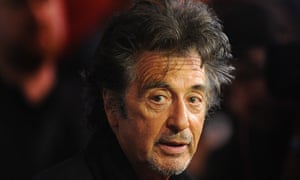
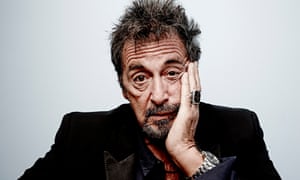
In person, Pacino is by turns playful and mournful, not quite the wide-eyed buffoon of the talkshow circuit, nor the fiery grump of Wilde Salomé, the documentary he made about directing Oscar Wilde’s Salomé on Broadway. He has a shock of thick, dark hair that wafts every which-way when he talks. He wears many layers of black, and chunky silver rings. Two good-luck pendants dangle into an open shirt front. He looks like a goth Rod Stewart.
Pacino leans forward. His intense stare is weakened by his sunglasses. He apologises for wearing them indoors: “I have an allergy and it’s come out.”
What is he allergic to?
“Who knows? Interviews …?” There is a long pause. “Just kidding,” he says.
The sunglasses don’t last long. He takes them off in the midst of a complicated ramble, which, it turns out, is a bit of a speciality (“You have to be with me 50 years before you can get a sense of what I’m talking about,” he once said). He looks tired, but kindly. I was nervous about meeting him. I didn’t know which Pacino I was going to get. There’s a scene in Wilde Salomé where the actor gripes about the promotional material for the show’s run. “PACINO IS BACK!,” screams a poster’s banner headline. “Pacino is back?!,” he yells. “This is the problem with my whole life. What the hell does that mean?! How am I going to live up to that?”
The real guy – for the half hour I am with him, at least – is canny, patient, riled only once.
Let’s tentatively call Manglehorn a return to form. It is, at least, a refreshing break from a run of lumpy crime dramas (The Recruit, 88 Minutes, Righteous Kill) and awkward cameos (Gigli, Ocean’s Thirteen). It’s a low-key movie, shot on-the-fly, requiring Pacino to leave New York and decamp to Austin. Which, he says, is tough: “I like sleeping in my own bed. I like to be near my kids” [14-year old twins Anton and Olivia (he shares custody with Beverly D’Angelou) and another daughter, 25-year-old Julie]. He’s paternal, in a distant way. I mention to him that I’m going to be a dad soon. “Oh my! You got a wife you like? That’s good. That’s a start. It does change you in a way that’s unexpected. If you like that sort of thing … it’s a great thing.”
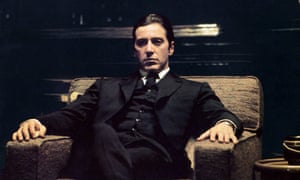
Pacino as Michael Corleone in The Godfather Part II, 1974. Photograph: Cinetext/Allstar Colle
You hire Pacino, you get his reputation. Manglehorn is not immune to the actor’s influence. The furniture of the bank set mimics that in Dog Day Afternoon (in which he played a luckless thief caught stealing to pay for his transsexual lover’s sex-reassignment surgery). “The world is yours,” Manglehorn tells a security guard as he slumps out to face another day. The film is intended as “an insider’s love letter to people who know his career”, says Green, and such homage also emphasises the difficulty in shelving those roles that came to define cinema culture and Pacino himself: Michael Corleone in The Godfather and The Godfather Part II, Sonny in Dog Day Afternoon, Frank Serpico, Scarface’s Tony Montana and Frank Keller in Sea of Love.
I ask Pacino if we should read anything into his recent film choices. Does he ever feel, like the actor in The Humbling, that his talent has deserted him? After all, he has been doing this for so long now and …
“OK.”
“I didn’t mean that as an insult.”
“I’m not insulted. I’m sitting here with you. How long is long? Four hundred years? Five hundred years? I don’t know what you’re talking about when you say long. What are you supposed to do? Quit?”
“Would you?”
“I have no desire to quit. Sorry. Why? Why didn’t I quit 20 years ago, 40 years ago? What’s the point of quitting?”
There is a pause as he decides which way to take it, then decides to be magnanimous.
“Listen, I’m trying to tell you something. I had a friend who died of cancer at 35. Thirty-five is young. I was sitting with him a good deal of the time and at one point he said to me: ‘I want to tell you something I’ve learned: three months, 30 years.’ No difference. That was the insight that he got when he was close to death. And I understand that.”
Pacino’s voice is gentler than you would expect, even exasperated. It doesn’t rocket up in volume as the impressionists suggest. We are sitting in a glass dining room in a hotel canteen in Toronto. The familiar Bronx growl bounces gently around the room, just loud enough to attract the attention of a passing waiter, who flits back and forth, peeping at Pacino.
“A painter can be 100 and paint a group of college kids playing football,” Pacino says. “It doesn’t matter, because he’s not playing football. He just grabs a brush and does the strokes. That’s the difference [with age]. That’s really all it is.”
It’s unfair to expect the actor to remain as distinctive as he was 40 years back, says Karina Longworth, author of Al Pacino: Anatomy of an Actor. “People think they have an idea of Al Pacino based on performances in movies like Scarface, but most people forget the moments of grace that make those performances interesting,” she says. “His career encompasses so much more than the six or seven films that are associated with catchphrases, but the sheer repeatability of something like ‘Hoo-ah!’ allows those performances to overshadow everything else.”
Still, it’s an odd time to be a Pacino fan. He has remained a method actor, even if he dispensed a while ago with the actorly intensity. In public, he is garrulous and a little eccentric, rich pickings for the fans who delight in seeing that outrageousness up close. In the past few years, he has topped up his crust by flogging seats on his private jet, passes to backstage meet and greets and tickets to the world tour of an onstage Q&A series called An Evening with Pacino that paved the way for other stars – Schwarzenegger, Stallone, Travolta – to follow suit. He is a veteran artist forced into a modern celebrity – something he distills brilliantly in Wilde Salomé. One minute he’s raging at the producers for putting pressure on his rehearsal time (“Fuck them”), the next he is gamely pretending to machine-gun a fan who is doing a Scarface impression.
“When you’re Al Pacino people want you to be larger than life,” says Green. “But he’s never going to be everybody for everybody. He told me he admires The Rock because The Rock knows how to switch it on for his fans.”
Still, it’s an odd time to be a Pacino fan. He has remained a method actor, even if he dispensed a while ago with the actorly intensity. In public, he is garrulous and a little eccentric, rich pickings for the fans who delight in seeing that outrageousness up close. In the past few years, he has topped up his crust by flogging seats on his private jet, passes to backstage meet and greets and tickets to the world tour of an onstage Q&A series called An Evening with Pacino that paved the way for other stars – Schwarzenegger, Stallone, Travolta – to follow suit. He is a veteran artist forced into a modern celebrity – something he distills brilliantly in Wilde Salomé. One minute he’s raging at the producers for putting pressure on his rehearsal time (“Fuck them”), the next he is gamely pretending to machine-gun a fan who is doing a Scarface impression.
“When you’re Al Pacino people want you to be larger than life,” says Green. “But he’s never going to be everybody for everybody. He told me he admires The Rock because The Rock knows how to switch it on for his fans.”
Pacino says his attitude to working now is inspired by a mantra that method acting guru Lee Strasberg drilled into him when Pacino’s profile exploded in the 70s: “Darling, you simply have to adjust.”
How far might he flex? There has been speculation that he would appear in a Marvel film. It was spurred by news of a meeting with studio head Kevin Feige, after Pacino said he enjoyed Guardians of the Galaxy. Mark Millar, who wrote the comic on which the next Marvel blockuster will be based, approves.
“We actually talked about Pacino for the first Kick-Ass film,” Millar says. “I remember sitting in the pub with Matthew [Vaughn], running through who could play the crime boss Hit-Girl takes down. The first three names were: Pacino, De Niro and Jack Nicholson. Then we realised how physical the part was going to be and decided to go a generation younger. But can you imagine how mental that would have been? Scarface getting kicked to death by a 10-year old girl and then blown up with a rocket-launcher?”
Michael Radford, who directed Pacino as Shylock in the 2004 film of The Merchant of Venice, is gathering finance for a Napoleon biopic, starring Pacino (he’s an inch taller than Boney, and 25 years older than the general was when he died). “Al is not somebody who interests the younger generation unless they’re film fanatics,” Radford says. “My kids and their friends? He doesn’t appear on their radar. Michael Fassbender and Tom Hardy do. At the same time, he’s a star for three-quarters of the world. Scarface has … become a kind of totem for all immigrant populations everywhere.”
Radford caught one of Pacino’s Q&A sessions. It wasn’t the onstage banter that stuck with him. “He tells the Al Pacino story,” he says. “It’s very entertaining, but it’s preceded by a montage of all his roles that shows how staggering he is.”
I see the Pacino roadshow in full effect a couple of weeks after we meet. He is being presented with a BFI Fellowship at a black-tie bash. A ragbag of talent – Joan Collins, Richard E Grant, Tom Hooper – clog the reception room. Pacino ambles in and acts delighted. Works the room, plays the part. But it is, despite the glamour, sentimental in a way that Pacino isn’t.
I ask him about death in our interview. He is very matter of fact about it. “You don’t think about it yet, but it will come to you,” he says. “It’s a tunnel, see? And when you’re about 36, for the first time in your life, you look and way down in the distance there’s this tiny, tiny light and you say: ‘Oh! I didn’t know what was there!’ It’s an awareness that comes to us.”
At the reception, the montage of clips from his classic films (mostly pre-1980, no Jack & Jill here) is played before dinner. It’s the same kind of showreel you’d see any given year at any honorary ceremony, but Radford’s right: something clicks.
The young Pacino collects the gun, smooths his hair and walks back to the table tofinish dinner with Sollozzo. He pleads for the captain to air the department’s dirty laundry. He tells that flunky pig to get back. The dining room goes quiet. The genius cuts through the glitz. “He wants to kill me so bad he can taste it!” screams the onscreen Pacino. “Attica! Attica! Attica!” For a brief moment, the art is alive again.
‘The lowest point of my life was losing my mother, Rose, and grandfather – they died within a year of each other’: Al Pacino. Photograph: Maarten De Boer/Contour by Getty Images
I’ve learned to live without anonymity. I haven’t been in a grocery store or subway for years. It’s hard for my children to go out publicly with me. Fame is different now than it was 20 years ago – I don’t know what the hell it is now! If I have a rare time of being somewhere and not being recognised, it’s a luxury.
It’s never been about money for me. There were times when I was young when I could have used money: after college I was often unemployed and at one time I slept in a storefront for a few days. But I’ve never been materialistic. Except that I am, of course, because my lifestyle makes me a spender!
My grandfather, James Gerardi, taught me about work. He was a plasterer and work – any kind of work – was the joy of his life. So I grew up wanting to – it’s what I’ve always chased. The joy of work is what keeps me going.
The conclusion of my teachers was that I needed a dad. I wasn’t an out-of-control teenager, but I was close. My parents divorced when I was two and my father wasn’t in my life from then. I wanted to be different with my children [Julie, 25, and twins Anton and Olivia, 14]. I wanted to be responsible to them, so I divide my time between two coasts.
Kids changed my perspective. Before I had my three, I’d walk around in my own head, not noticing anything. Acting used to be everything; now, because of them, it’s just a small part.
I’m not lacking in friends. We can all get caught up in our lives, our careers, but I’ve always understood there’s a certain tenacity needed for friendship.
The lowest point of my life was losing my mother, Rose, and grandfather – they died within a year of each other. I was 22 and the two most influential people in my life had gone, so that sent me into a tailspin. I lost the 70s in a way, but then I gave up drinking in 1977 and decided to focus on the work.
I understand the value and power of social media, although I don’t really do it myself. I have a Facebook page that 5.4m people “like”. What does that mean? I don’t know, although I do appreciate that these platforms are good for getting your message out there.
Michael Corleone in The Godfatherwas and still is the most difficult role I’ve played. I didn’t see him as a gangster; I felt his power was his enigmatic quality. Unfortunately the studio couldn’t see that at first and were thinking of firing me. It was during my early career, a major movie with Marlon Brando, and no one other than Francis [Ford Coppola] wanted me for the part.
My grandparents came from a town in Sicily called Corleone. Fate? Yes, maybe – it’s very strange. But then life has so many twists and turns.
People think there is rivalry between me and Robert De Niro. I know Bobby pretty well. He’s a friend and he and I have gone through similar things. I love what he does with comedy; it’s pure genius.
I believe I have reached my stride, which is why I persist. As long as you have passion for the art, keep working, because age catches up with you.